7. FAQ (Q & A)
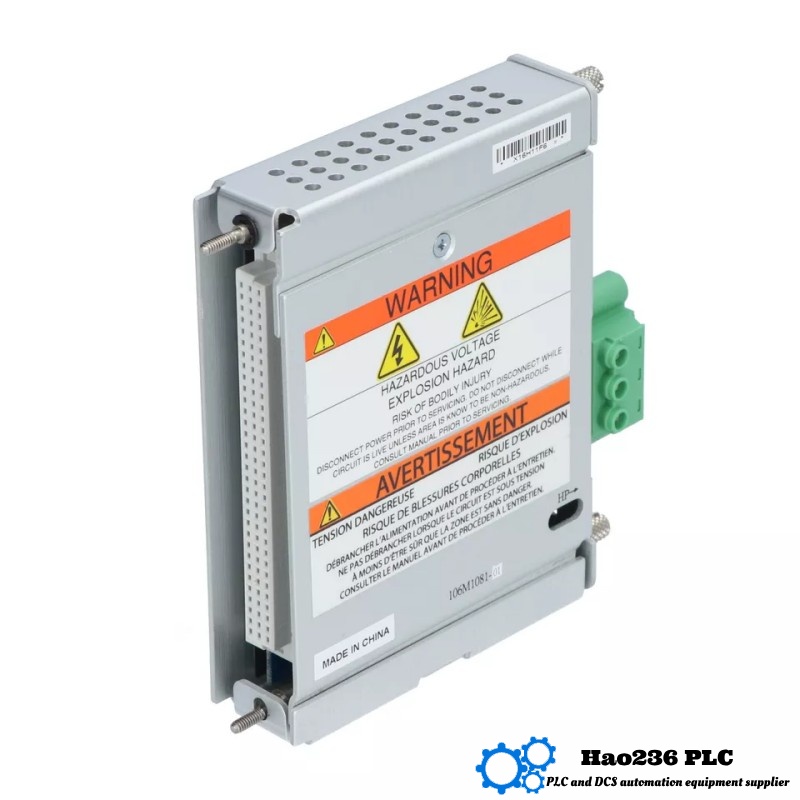
Q1: What do the suffixes “+106M1081‑01” represent?
A1: The “+106M1081‑01” denotes that the base module is expanded with an additional I/O and/or communication extension board.
Q2: What kinds of sensors can connect to this unit?
A2: It accepts proximity probes, vibration sensors (velocity, acceleration), or displacement transducers—configurable per channel.
Q3: Can encryption be used over Modbus or Ethernet?
A3: Native encryption is not built in. Secure communication must be handled externally, e.g., via network gateways or VPNs.
Q4: Is hot-swap installation supported?
A4: Modules can be replaced with power off only. Live swapping is not supported due to risk of signal interruption.
Q5: Can analog outputs be scaled?
A5: Yes, analog output ranges and zero/span values are configurable through a dedicated setup utility.
Q6: Does it support remote firmware upgrades?
A6: Yes, via RS‑485 or Ethernet (if present), following a defined firmware update protocol, requiring reboot.
Q7: Is there an onboard buffer for event logging?
A7: There’s limited fault and event memory, but full data logging must be offloaded to an external monitor or historian.
Q8: What sort of maintenance is advised?
A8: Annual inspection of wiring, firmware updates, verifying relay operation, and calibration of analog outputs.
Q9: Can I integrate this into a safety-instrumented system (SIS)?
A9: Yes, relays can be wired into safety circuits; however, the module itself isn’t certified as an SIS element.
Q10: What happens in a power loss scenario?
A10: On power loss, the system resets. Relay outputs default to safe state (open or closed, per configuration), and network communication drops.
Related Products
Copyright @ 2026 Automations
XML|Links:
No:77501