7. FAQ — 10 Questions & Answers (QA Format)
Q1: What does “TMR” mean in the 3500/34 TMR relay module?
A1: TMR stands for Triple Modular Redundancy. It means the module has three internal relay paths for each output, and uses a 2-out-of-3 voting scheme to determine final output, improving fault tolerance.
Q2: If one internal relay fails, does the channel still operate?
A2: Yes. In a 2-out-of-3 architecture, if one path fails, the remaining two still vote and maintain output, so operation continues.
Q3: Can the 3500/34 module be hot-swapped?
A3: For safety, it is recommended to power down the rack before replacement. Hot-swap is not advised unless the system supports it explicitly.
Q4: How is logic / alarm drive programmed?
A4: It is configured via the 3500 Rack Configuration Software. Each output channel’s logic (AND, OR, etc.) is mapped to alarm inputs or status bits from monitors.
Q5: What kinds of loads can the external relays drive?
A5: The module typically can handle moderate loads—on the order of 2 A or so at standard voltages. Heavier loads require additional contactors or drivers.
Q6: What is the typical power consumption of the module?
A6: Around 9.6 W (typical) under normal operating conditions.
Q7: What are the module’s limits on temperature and humidity?
A7: Operating temperature range is –30 °C to +65 °C; storage range –40 °C to +85 °C. Humidity tolerance up to 95%, non-condensing.
Q8: How do I detect internal failures or degraded module health?
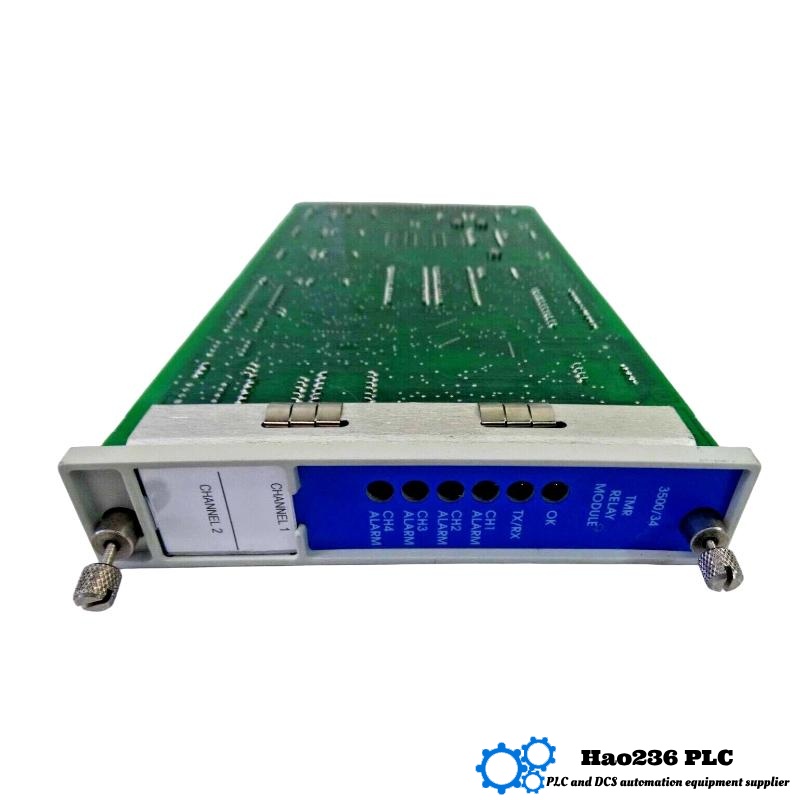
A8: The module typically provides LED diagnostics (OK, channel alarms, TX/RX) and reports status to system software. If an internal path is bad, the module flags it.
Q9: Can multiple 3500/34 modules be used in one 3500 rack?
A9: Yes, more than one can be installed if more output channels or redundancy is needed, as long as the rack has slots and power capacity.
Q10: How is wiring for the I/O module handled?
A10: The I/O module is often a rear-mounted module connected to the relay module; wiring is done to output terminals there, with standardized backplane and terminal connections.
Related Products
Copyright @ 2026 Automations
XML|Links:
No:77501