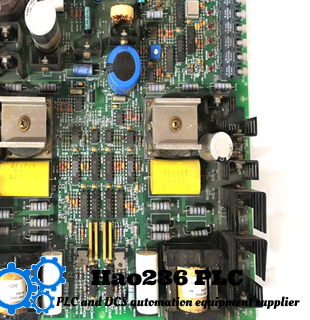
FAQs (10 Q&A)
Below are ten common questions and answers about DS200FGPAG1A.
Q1: What does “Gate Pulse Amplifier” mean, and what does this board do?
A1: Gate Pulse Amplifier means a module that amplifies control (“gate”) signals to drive power switching devices (SCRs), monitors their status (via cell voltages), and provides power (via switching power supply) required to run those functions. This board takes weaker logic signals and turns them into strong gate drive outputs, and monitors feedback.
Q2: Why are fiber‑optic connectors used in this board?
A2: Fiber‑optics are used for status communication (SCR cell status, etc.) because optical communication is immune to electromagnetic interference that is very common around power electronics such as SCR bridges. They help preserve signal integrity.
Q3: What are the test points for, and how many are there?
A3: There are 30 test points on the board: 9 for Gate A, 9 for Gate B, and 12 for cell status monitoring. These allow technicians to probe signals or voltages directly for diagnostic or troubleshooting purposes without disassembling the module.
Q4: What voltage levels does this board accept and convert?
A4: It accepts very high AC voltages from the converter supply (often ~ 2080 VAC or ~ 3300 VAC for the twelve‑pulse converter supply), and converts needed parts to DC control voltages for gate circuits and status monitors.
Q5: What is the operating ambient temperature range for DS200FGPAG1A?
A5: Typical operating range is –20 °C to +70 °C; storage range is wider (–40 °C to +85 °C).
Q6: Is this module backwards compatible with older GE Mark IV or earlier boards?
A6: No; it is specified as not backwards compatible. That means older control racks or older interface layouts may not support it directly. When replacing, one must verify rack compatibility, connector pin‑outs, firmware or control logic compatibility.
Q7: What are the key safety / protection features?
A7: The module features optical isolation, robust switching power supply, status monitoring for cell voltages, proper test points for diagnostics. Also likely includes protection for over‑voltage, over‑current or gate driver failure.
Q8: How large/heavy is the module?
A8: Dimensions are about 311 mm × 112.5 mm × 140 mm; weight is approx. 1 kg.
Q9: Where is this module used in the control chain of a turbine or power electronic system?
A9: It sits between the control logic (that issues gate commands) and the power switching devices (SCR bridges). It drives the gates, monitors them, and feeds back cell / SCR status to the logic controller (LCI or other).
Q10: What are the common causes of failure for this board, and how to maintain it?
A10: Common failure causes include thermal stress (if cooling is insufficient), electrical stress (over‑voltage or surges), optical connector damage, dust/moisture contamination, connector pin corrosion. Maintenance should include periodic inspections, cleaning, checking test point readings, verifying gate drive waveforms, ensuring proper power supply, replacing worn components, and keeping spare modules on hand.
Related Products
Copyright @ 2026 Automations
XML|Links:
No:77501