7. FAQs (Q / A)
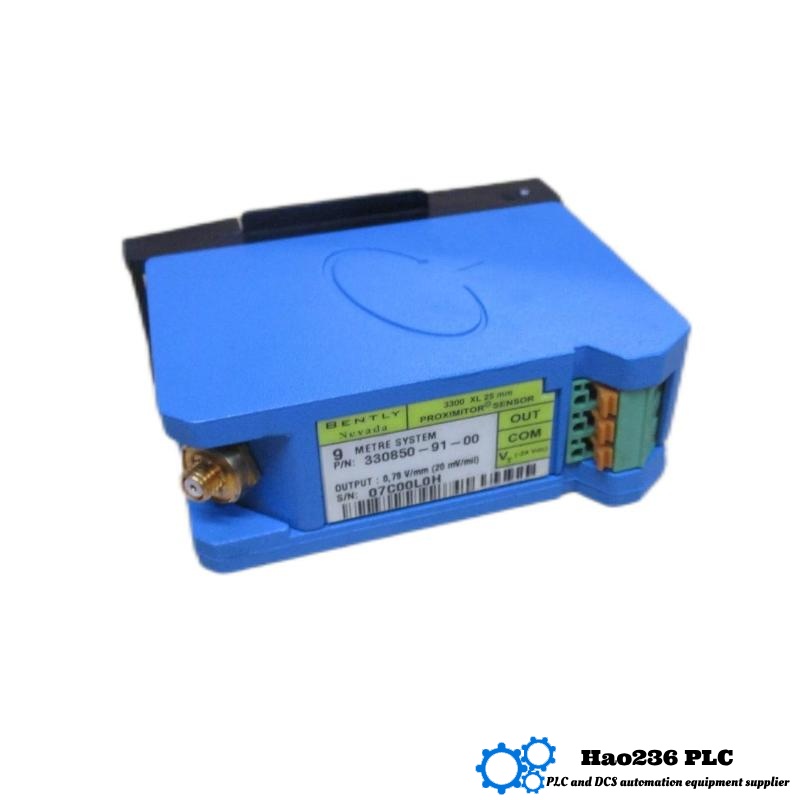
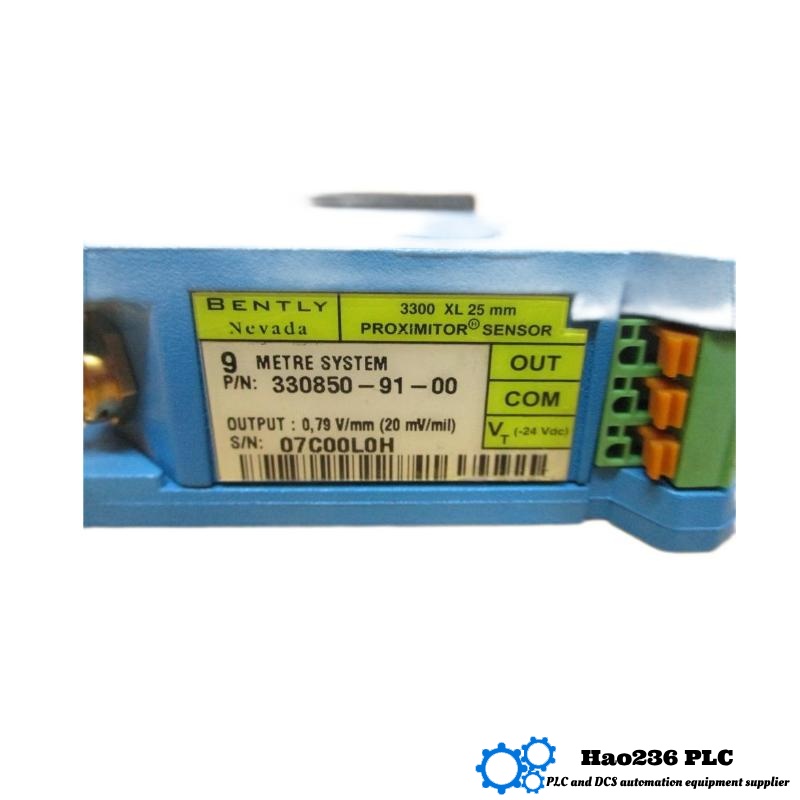
Q1: What does the “91” designate in 330850‑91‑00?
A1: It typically indicates a 9.1 metre system length and DIN-rail compatible mounting style (i.e. the “91” variant is intended for DIN or rack-mounted installations).
Q2: Why choose 330850‑91‑00 over 5 m versions?
A2: Because machinery layout or cabinet placement may require the probe electronics be located several meters away. The 9.1 m reach allows installation flexibility without using signal repeaters.
Q3: What does the “00” suffix mean?
A3: “00” denotes a non‑approval version without additional regulatory or hazardous-area certifications. It is suited for general industrial environments, not zone-rated hazardous areas.
Q4: Is the 330850‑91‑00 compatible with other 3300 XL probes and cables?
A4: Yes. It shares the same probe interface, extension cable types, and signal characteristics as other 3300 XL 25 mm modules, enabling easier upgrades or replacements.
Q5: What range of displacement can it detect linearly?
A5: The linear zone is approximately from 0.25 mm up to about 25 mm; beyond that, the output will enter non‑linear or saturation zones.
Q6: What is its size and weight?
A6: The proximitor module is about 78 × 60 × 65 mm in physical size, and weighs approximately 0.22 kg. When packaged with accessories, the shipping weight may be between 1.5 and 2.0 kg.
Q7: How does it handle electromagnetic interference (EMI / RFI)?
A7: It incorporates industrial-grade shielding and filtering to protect the measurement signal in electrically noisy plant environments, though not to the level of hazardous-area certification.
Q8: Can I calibrate this sensor in the field?
A8: Yes, field calibration is possible (zero / span checks) provided that you have proper calibration tools and reference standards. However, factory calibration ensures highest accuracy.
Q9: What is the expected operational life?
A9: With proper installation, environment control, and maintenance, the device can reliably operate for many years (often 5–10+ years) with low drift.
Q10: Can this sensor measure non-ferrous materials?
A10: It is designed primarily for ferrous (steel or iron) surfaces; measurement accuracy with non-ferrous targets (aluminum, copper) is reduced and not recommended for critical monitoring.
Related Products
Copyright @ 2026 Automations
XML|Links:
No:77501