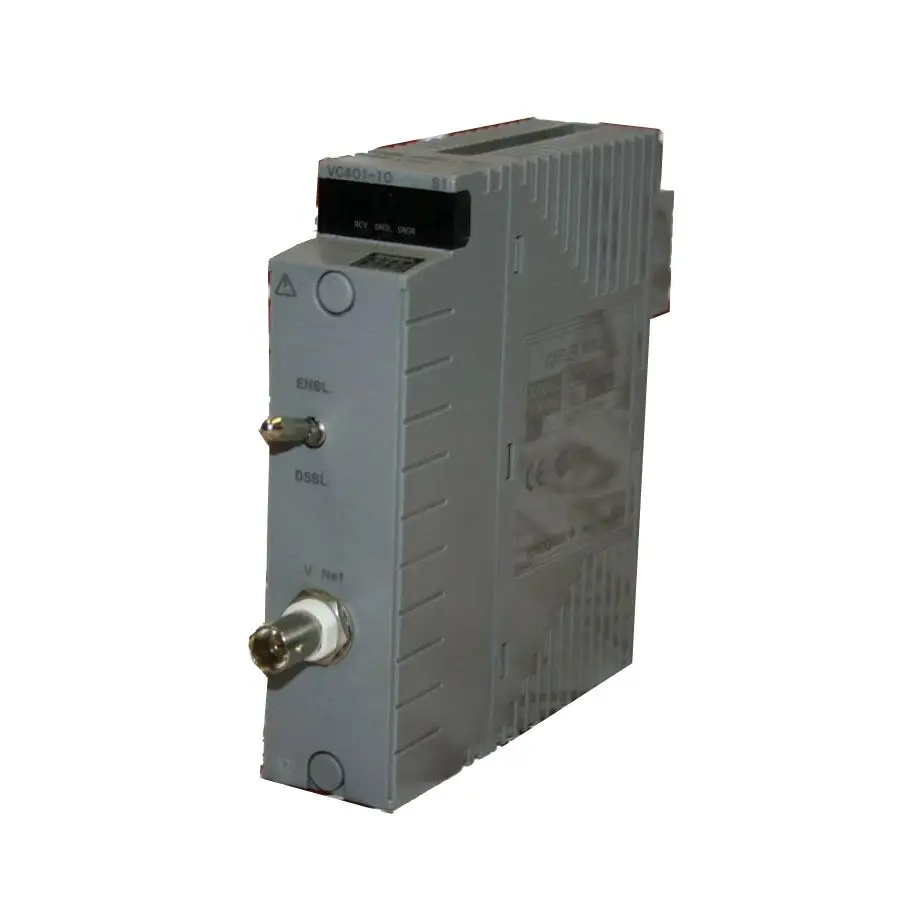
FAQ (10 Questions & Answers)
Q1: What is the primary purpose of the VC401‑10 module?
A1: It serves as a modular coupler in Vnet systems to join network segments, connect remote modules or racks, and handle control/status data transmission within an automation network.
Q2: What power does it require?
A2: 24 V DC; often with dual or redundant power input capability to enhance reliability.
Q3: What temperature range can it operate in?
A3: Typically from −10 °C to +55 °C for operating; storage range somewhat more extreme.
Q4: Is the module hot‑swappable?
A4: Yes, in many system configurations it is designed to be replaced (or inserted) without shutting down the network segment.
Q5: What are its physical size and weight?
A5: Roughly 100 mm × 68 mm × 26 mm, weighing about 0.20 kg.
Q6: What data throughput can it handle?
A6: On the order of ~100 Mbps in typical coupler mode, sufficient for control/status communications rather than heavy data streaming.
Q7: Is it compatible with other Vnet modules?
A7: Yes; designed to integrate with other modules in the Vnet series (remote I/O, communication modules, etc.).
Q8: What are its advantages in maintenance or reliability?
A8: Compact size, dual power inputs, hot‑swap capability, and durable design all help reduce downtime and improve reliability.
Q9: Is the module rated for harsh environments (humidity, vibration)?
A9: Yes; tolerates moderate humidity (non‑condensing), typical industrial vibration; exact vibration specs depend on system rack mounting.
Q10: For what kinds of industrial applications is VC401‑10 best suited?
A10: Process control, SCADA, remote I/O, network segmentation in DCS, control racks expansion, modules in chemical, power, oil & gas, and similar industries.
Related Products
Copyright @ 2026 Automations
XML|Links:
No:77501